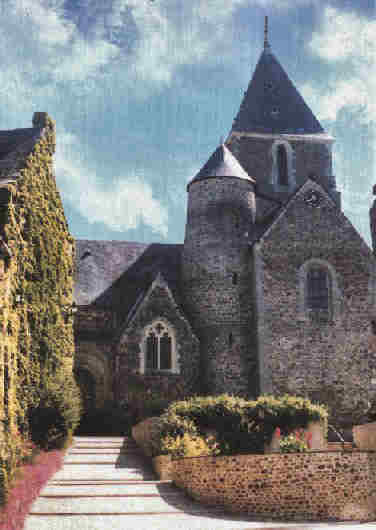
The Wars of Religion and fortified churches
THE WARS OF RELIGION AND FORTIFIED CHURCHES
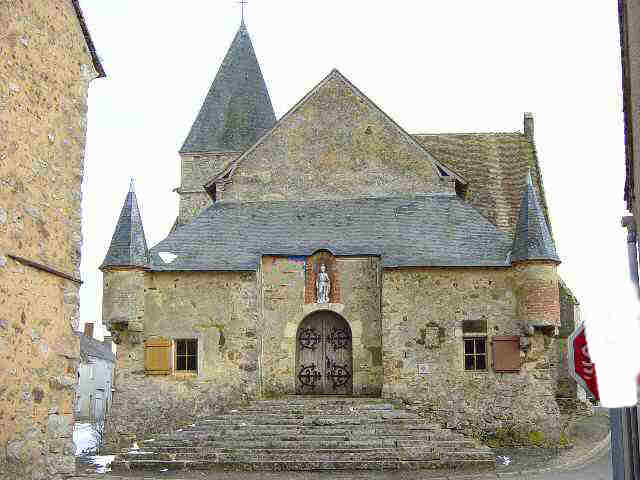
Is this a miniature Azay-le-Rideau built at the Renaissance by a hard up nobleman? The lean-to roof was added much later (19th c.) in place of the bartizans, loopholes and crenellations. I
In fact, beneath this 16th-century shell, is an almost intact 12th-century Romaneqsue church
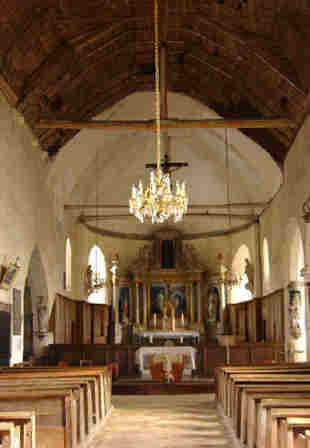
For three centuries, generations of viillagers prayed in this modest Romanesque church, often threatened by wars and epidemics, but enjoying a relative tranquillity.
Then, from the 1540s to 1599 ( Edit de Nantes) - more than four decades - armed conflicts between Protestants (Huguenots) and Catholics caused thousands of victims and countless acts of vandalism. Catholic villages and towns had to organize their defence
he first objectives were, of course, catholic churches and chapels, and the villagers began to fortify them.
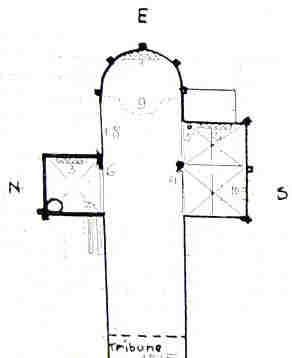
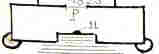
P- for example, a fortified forecourt was added and separated from the nave by a door that was locked and barred in case of emergency. (the dotted line)
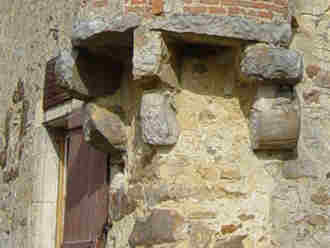
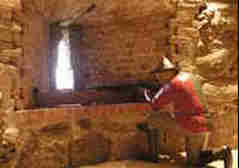
Arquebus loophole in the south hartizan
The entrance was defended by the crossed fire of arquebuses concealed in the two turrets or bartzans. Some loopholes (now obsolete) were still used by individual archers. Moreover, the besieged could hurl all sorts of missiles from the machicolation and crenellation of the façade. (the roof did not exist) - l
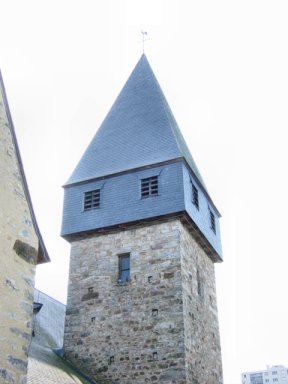
Church tower surmounted by a "hourd": an overhanging wooden gallery surmounting a tower or a wall. ike its stone equivalent (machicolation) it enabled the besieged to bombard the attackers with all kinds of missiles.