Hands
When a child - or an adult , if he is not an artist - tries to draw or paint a human figure, the trickiest parts are the hands and their five fingers, particularly if they hold an object or another hand.
All artists, including, of course, those of the Romanesque period, the Renaissance and the so-called baroque style, faced the same problem and the degree of realism with which hands are represented often allows us to date the painting or drawing. It is even more obvious for wall paintings, which were executed rapidly and whose size highlights all imperfections.
Medieval artists were fundamentally concerned in representing the essence of biblical scenes with no concern on technique details. The background is always simple and without any perspective. Hands are often simple, even crude.

1)2) 3)
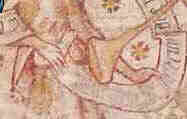
This 14th-century musician angel's left hand shows five independent fingers but they do not really "curl" around the scroll and look stiff.
The thumb also looks straight and stiff .
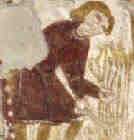
In this fragment of a "Labours of the Months" scene, a peasant is cutting wheat, he isholding a handful of wheat in his left hand and a sickle in the right one. You will notice that his fingers do not flex and curl to grasp the wheat.
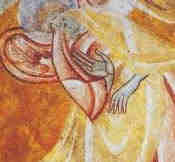
Here is an example of a hand, which is perhaps not realistic but anatomically correct: relative length of the index and middle finger, which are not stuck together, ring and little fingers that flex elegantly, characteristic swelling of the thumb, whose third phalanx is correctly curved. This Romanesque painting was obviously executed with great care and skill.
4) 5)
Compare with the stiffness of picture 4 et the elegant but anatomically inaccurate hands in picture 5.
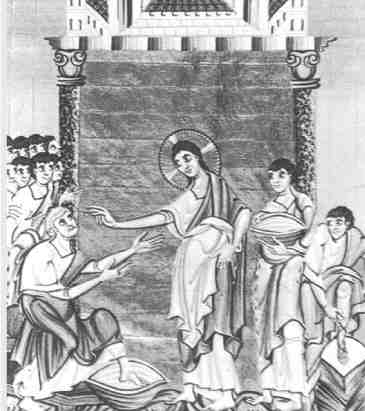
Medieval art: The scene represented in the Book of the Gospels of Otto III (1000 aC) refers to the Gospel of St. John, where he reports the episode after the last Supper, when Christ washed the feet of the apostles. The artist was fundamentally concerned in representing the essence of the report by St. John, with no concern on technique details. The background is simple and without any perspective; the central scene is Christ's blessing in face of the supplicant gesture by Peter(7). Christ's hands are simple, and the right one has flexion of fingers 4th and 5th. Peter's hands have some size proportionality of the fingers, and the first commissure is enhanced, and a drawing of the hypothenar eminence of the left hand is represented (Figure 4).
6)7)
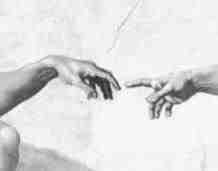
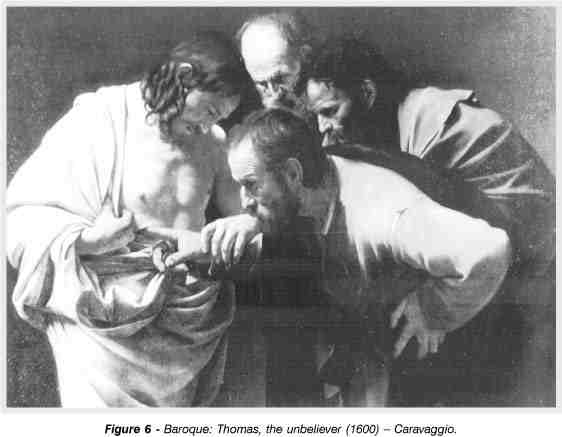
With the Renaissance and above all the baoque style a peoccupation with realism appears - painted hand must look like real hands: imitation of the colour of the skin and nails even showing, as in the famous painting of picture 6, the dirt under the thumb's nail.