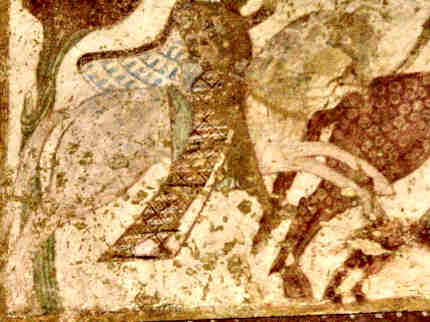
All creatures
ALL CREATURES GREAT AND SMALL
Au moyen-âge, le monde animal est à la fois mal connu - de nombreuses espèces sont totalement inconnues - et présent dans la vie de tous les jours:
In the Middle Ages, the animal world was both hardly explored -many species were totally unknown - and very present in everyday life:
sous forme de nourriture (viande,gibier, poisson)
in the form of food (meat, venison, fish)
comme source d'énergie ( labours et moulins)
as a source of energy for ploughing and also for mills)
comme source naturelle d'engrais
as a natural source of fertilizer
comme matière première pour les vêtements (laine, fourrure, cuir)
as material for clothes (wool, fur, leather)
comme moyen de transport (chevaux, boeufs, chariots)
as a means of transport(ation): horses, oxen, carts)
pour l'éclairage ( cire, huile , suif, )
for lighting (wax, oil, tallow)
pour la défense et l'attaque: (chevaux)
for defence / defense or attack: horses
Certains animaux vivent en compagnie de l'homme, même si cette compagnie n'est pas souhaitée et mêmesi elle est redoutéeLa souris et les mouches appartiennent à la première catégorie; les rats et les serpents à la seconde
Some animals live in the company of man, whether he likes it or not , or even if the company is unpleasant or even menacing. Mice and flies belong to the first category; rats and snakes to the second.
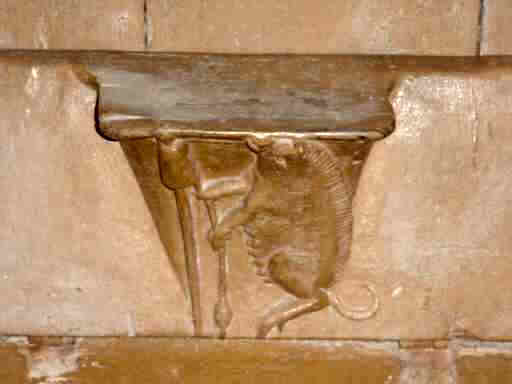
The members of the Chapter, who stood in the stalls round the chancel, were sometimes allowed to sit or lean against folding wooden seats known as miséricords. The visible part, when the seat is lifted, thus hidden by the standing or leaning monk, is often carved with animals or amusing scenes "The suggestion - the monk sitting on the hedgehog - is all the more disrespectful as the beast is often part of coats-of-arms, whose motto is: "Qu'y s'y frotte, s'y pique!" (if you do not want to be stung, stay away!)
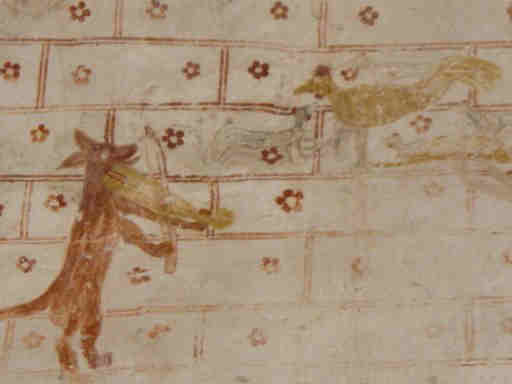
This XIIth-cntury wall painting illustrates one of the numerous "fabliaux" , whose "heroes" are Goupil, the fox, and Ysengrin, the wolf, which, originally, in the Roman de Renart, were only the names of two of the characters.
Ysengrin, standing on his hind legs, is playing the fiddle or the viol to lure a rooster down from its perch.
The masonry pattern is typîcal of the 11th or 12th century but the painting was added later
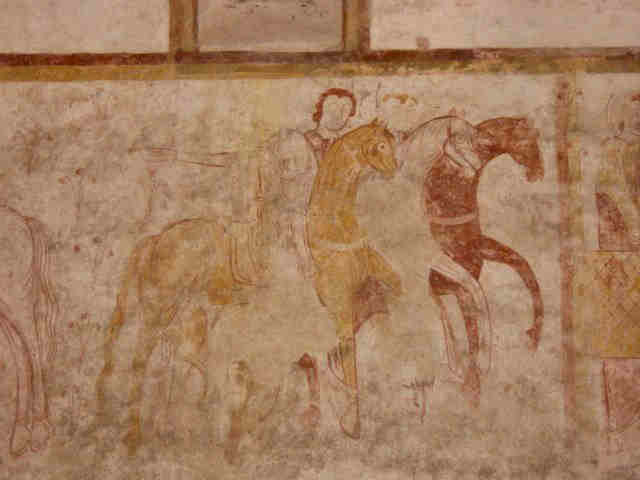
Men have tamed horses for a very long time, probably in prehistoric times somewhere in what is now Mongolia, However, the New World and Indians discovered them when the Conquistadores landed in the 15th century. (3 centuries after our horse was painted!)
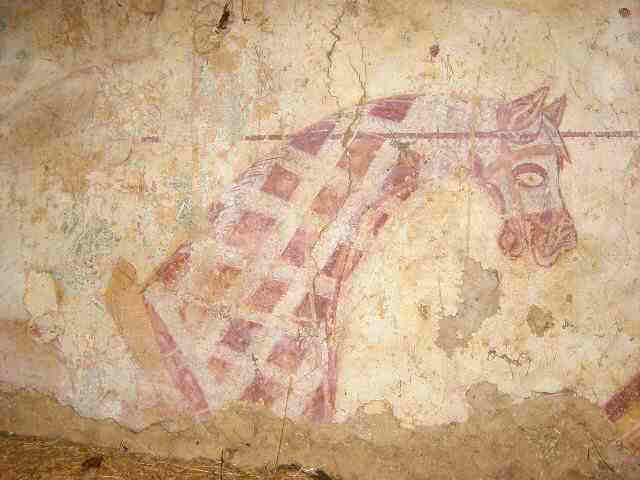
The horse, to medieval man, wasthe noblest of all animals. It had a enormous social importance (the equivalent of a stately home nowadays) and was really close to his master; closer even than the dog or the hawk - faithful hunting and hawking companions.
Pour un jeune ambitieux, posséder un vheval c'était un premier pas vers un titre de chevalier, le monde de la chevalerie et peut-être la noblesse. Quand un seigneur partait en guerrre ou se mettait à la tête d'une croisade, il recrutait ses troupes, soit par la force (des paysans pour la plupart) ou promettait à ceux qui venait à lui avec un cheval et une lance, un avancement rapide. Mais un cheval était un lourd investissement, son entretien était coûteux et, si notre chevalier voulait tenir son rang, il devait s'équiper de pied en cap - For an ambitious young man, owning a horse was a first step towards a knighthood, the world of chivalry (cheval = horse) and maybe nobility. When a local lord went to war or rode at the head of a crusade, he recruited troops either by force (mostly peasants) or promised those who came to him with a horse and a spear, quick promotion. But buying a horse was a heavy investment, his upkeep costly and if our knight wanted to behave like a one, he had to equip himself from head to foot
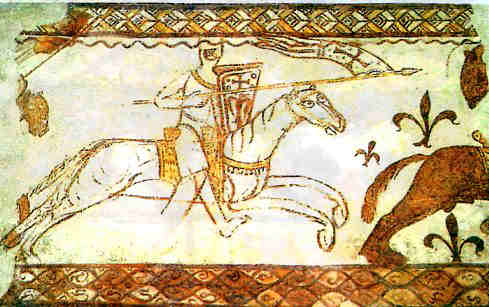
Chevalier telmlier chargeant au grand gallop. Son bouclier porte la criox de Malte ainsi que l'étendard qui orne sa kance - Knight templar garging at full gallop. His shield bears the Maltese cross like the standard adorning his spear