Home › Churches › Pays de la Loire
Asse-le Riboul
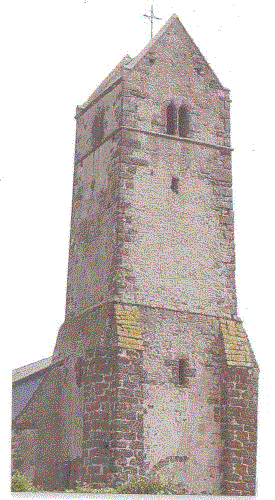
13th-century saddle-roofed bell-tower. The corner chains and buttresses are made of the local reddish-brown "roussard" sandstone.
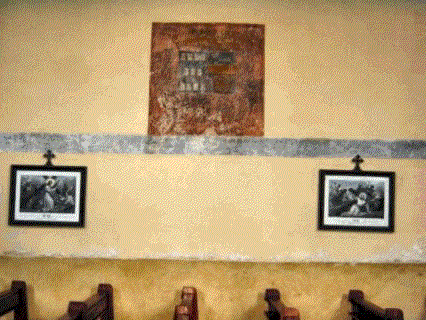
On the southern wall of the nave is a funerary "litre" (a black band bearing the coats of arms of the local lord or patron, painted on the walls of the nave on the occasion of their funerals). In Assé-le-Riboul, the coats of arms are those of two powerful families: the Beaumanoirs and the Rostaings. Motto of the Beaumanoirs: "J'ayme qui m'ayme", their war cry: "Bois ton sang, Beaumanoir!" (Drink your blood, Beaumanoir!)
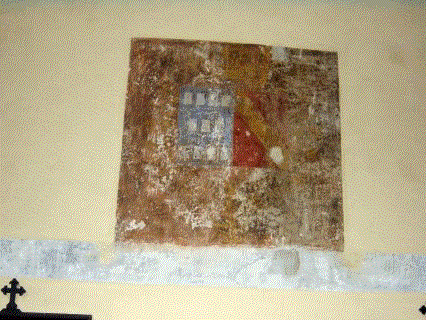
"Litres funéraires" and hatchments : a " litre funéraire ", from the Latin litura (painting) is a black band, about 2ft high, on which the coat of arms of the local lord was painted at regular intervals. These "litres" were painted on the interior walls of the nave and sometimes below the cornice of the chevet. The right to a "litre" was a great privilege reserved for the local lords. Originally - as early as the 12th century - a band of black fabric was put up in the church during the funerals of noblemen. Then the coats of arms were fixed to the black band, which was often painted directly on the wall. These escutcheons were generally painted on parchment but in the 14th century they were painted directly on the walls. Noblemen thus asserted the permanence of their right.
A hatchment is a painting of a coat of arms on a diamond shaped board. They were already common in England in the 17th century and the practice was widespread in the 18th. Originally, the actual shields of deceased persons were carried into the church and left there. In the late 16th century the real shields were replaced by hatchments. The word comes from the heraldic term "achievement." When someone died, not necessarily the local lord, a hatchment of their arms was hung over the entrance to their house and remained there for twelve months. It was then taken down from the house and set up in the church. In some churches they were then removed and ended on the rubbish heap, whereas in others they have been carefully preserved
HOME PAGE
Location and nearby churches
- Saint-Jean-d'Assé 6.1 km
- Fresnay-sur-Sarthe 9.3 km
- Meurcé 9.8 km
- Conlie 11 km
- Amne-en-Champagne 21 km
- Coulaines 21 km