Home › Churches › Pays de la Loire
Luché-Pringé
EGLISE SAINT-MARTIN
A brief history
Luché is probably one of the oldest parishes of the Diocese and it soon had its own church, as evidenced by the "Pontifical Acts of the bishops of Le Mans", mentioning Lucianum (Luché) among the 17 churches founded by Saint Aldric, 4th bishop of Le Mans (348-397), who dedicated it to Saint Apolline, a young Roman martyr. This choice was probably due to the fact that the first church was built on the site of a Gallo-Roman temple dedicated to Apollo.
UN PEU D'HISTOIRE
Only 6 centuries later was Luché mentioned again. This time, it was in the "Cartulary of Saint Aubin of Angers", which informs us that the church had been given by Raoul, Count of Maine, to the Monks of Saint Aubin in order to found a priory to be named after Saint Martin de Tours. The Holy Bishop had been the contemporary and friend of Liboir, the founder, which may be why we have such a glorious patron.
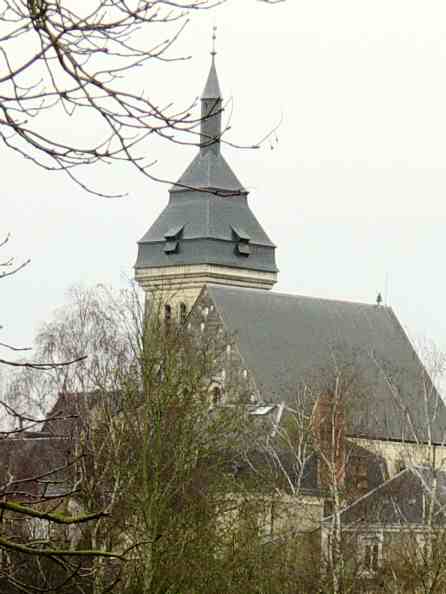
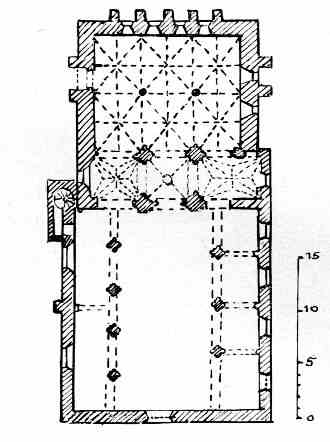
As the primitive church was probably too small, the monks, who had settled there since 1057, undertook the construction of a larger building: the one we know today. The erection of the choir and tower seems to have stretched from 1166 to 1255. This was the transition period between the Romanesque and the Gothic styles. During the same period the famous choir of the cathedral of Le Mans was being built. Later, in the 14th and 15th centuries, two modest transepts were added to the church and the present nave was erected only at the very beginning of the 16th century. The 4 centuries of the Gothic period are thus represented in this construction.
Over the centuries our church had to endure all the hazards of war. The Priory, adjoining the shrine was practically destroyed by the English during the Hundred Years War and the church suffered as a result of the clashes between Catholics and Protestants. Most of the local lords supported the Reformation. They were bent on destroying all that reminded them of popery. They committed the worst acts of violence, breaking statues and liturgical objects, burning books and furniture. Several statues have been found concealed in private properties, often mutilated, sawn off and disfigured. They had probably been the victims of this troubled period. The statue of Saint Anne, which you may have noticed in the forecourt, before entering the church, was found beheaded in the presbytery. The small Virgin accompanying it had been broken off.
During the Revolution, the church was put up for sale. It would have been demolished without the intervention of two generous inhabitants of Luché: M Pierre-François LEPINE, a farmer at la Brosse and René MARTIN, the blacksmith of the village, who bought it to be restored as a place of worship once peace had returned. We should be very grateful to them.
On June 27th, 1921, the tower was struck by lightning, setting fire to the numerous nests built there by crows and burning the whole building. Fortunately, the choir was spared but the nave was destroyed and the fine bells, which were the pride of all the inhabitants of Luché, melted in the fierce fire. Restoration work took years. For lack of money the last two bays had to be cut from the nave, creating the forecourt in front of the portal
NOT TO BE MISSED
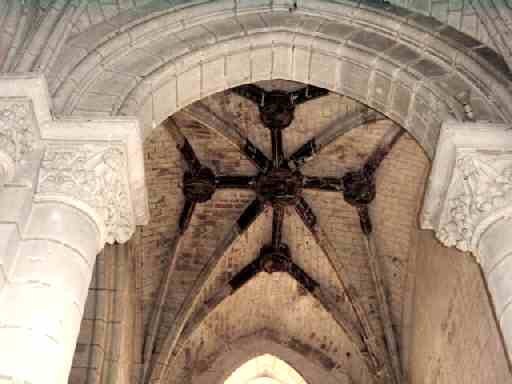
The magnificent Plantagenet Gothic choir, whose six domed vaults look so light that the two high and thin columns supporting them seem to do so effortlessly. This impression of exquisite lightness is produced not only by their elegant shape, but also by the groins that are underlined by curves adorned by fairly important ogee mouldings. The fairly thick walls are strengthened on the outside by numerous buttresses between which high, narrow windows have been pierced to let in the light, contributing to the beauty of the whole choir.
NE MANQUEZ PAS D'ADMIRER
The fine terracotta statues that adorn the choir:
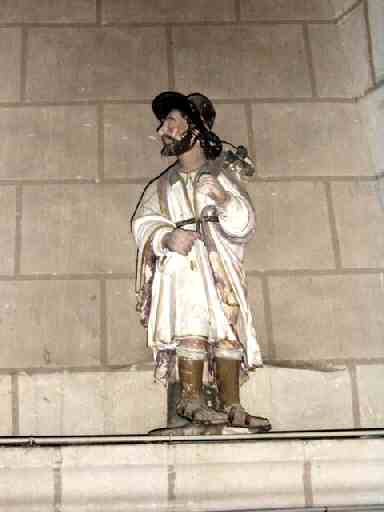
Saint Martin, with the attributes of an archbishop, dominating the altar, the four Evangelists, Saint Anne teaching the Virgin (dated from 1625), Saint Joseph carrying his joiner's tools in his bag. He probably held the bridle of a small donkey carrying Mary and her baby when they fled to Egypt as in a scene represented in the church of Moissac.
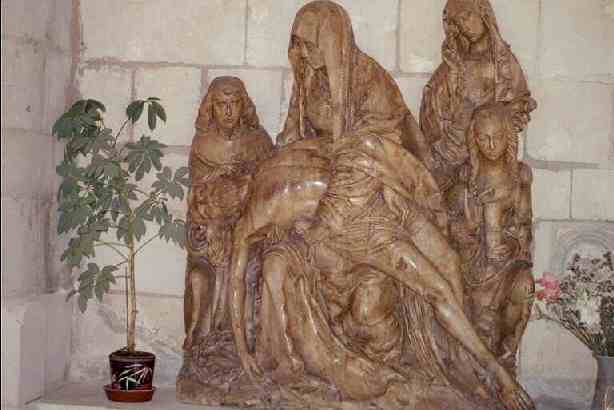
But above all the remarkable PIETA in the recess at the southern entrance end of the nave. The body of Jesus in his Mother's lap, surrounded by Saint John and the holy women is particularly interesting. It is composed of two huge blocks of walnut assembled by strong dowels. This remarkable piece dates back to around 1500 and might have been created by the studio of the School of Tours. The three main figures: (Christ, the Virgin and Saint John) show the same craftsmanship, but, on the right, in the folds of the holy women's clothes, there is definitely a refinement which, together with some other details, might suggest a Dutch influence. A student of the studio might have made a journey to Holland
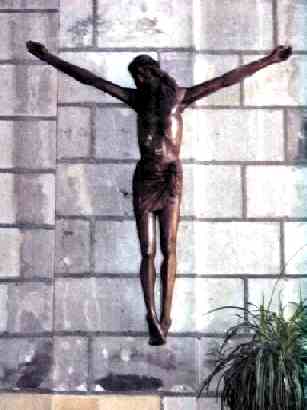
On the left of the Pieta, what remains of a beautiful 17th-century Christ, destroyed in the fire. The magnificent Christ from Pringé (temporarily stored here) against the wall facing the entrance. Carved out of walnut in the 16th or 17th century. Particularly striking are the elegance of its lines and the impression of serenity it gives. It was restored in 1980.
The Annunciation to the Virgin under the vault of the tower, is the work of Master Raymond Dubois, sculptor in Solesmes. Carved out of the trunk of a cedar tree from Gallerande's park, it was commissioned just after the last war to thank Mary for her protection.
Saint Antony of Padua (fixed to the northern wall). This small statue, modelled in fire clay, is the original work of Claude Gruer, who was also a sculptor in Solesmes and a former student of Raymond Dubois.
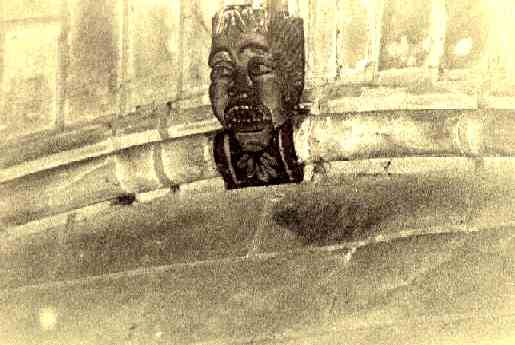
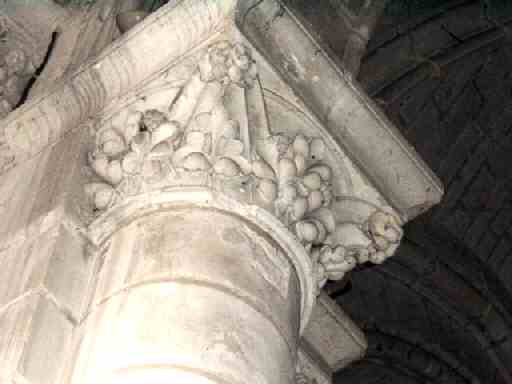
If you have enough time to stroll around, you will certainly discover other interesting details: patterns carved out of the stone, carved modillions at the base of the vaults, amusing capitals in the nave, finely wrought keystones in the transepts, etc
A reliquary bust of Saint Martin from the late 18th century. The baptistery and the pulpit have no archeological interest. They were made after the fire and were modelled those which existed before the disaster.
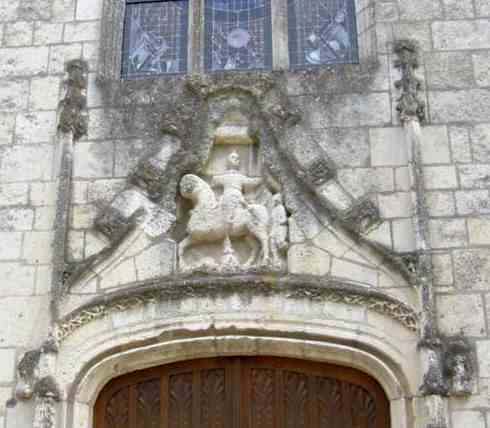
Bas-relief: Saint-Martin
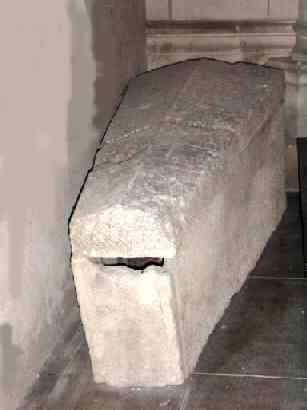
As you leave, you will notice a sarcophagus. It was found (with a number of others like it) in the basement of the nave. It may date back to the Merovingian times.
Outside is an elegant Renaissance manor. In fact, this building is the only vestige of the monastic buildings. Originally, it was a vast Gothic room (as evidenced by the window of the south gable) which must have been either the dining-hall of the Chapter house of the Priory. After the English destructions it was converted into a country house with an additional floor which required a staircase. The staircase explains the presence of the tower.
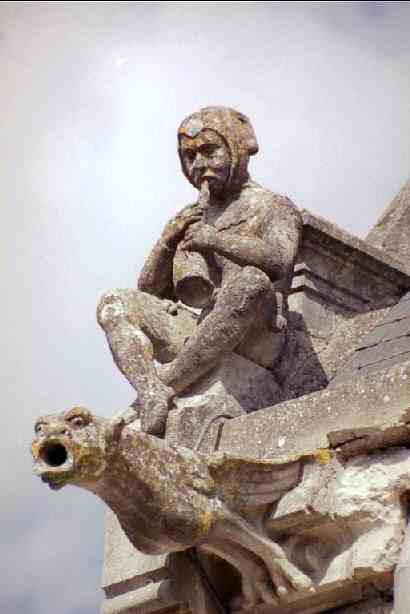
This fine home, probably the oldest in the village, was in a very poor state of preservation 20 years ago; these last few years it has been restored very tastefully and competently by its present owners.
PRINGE
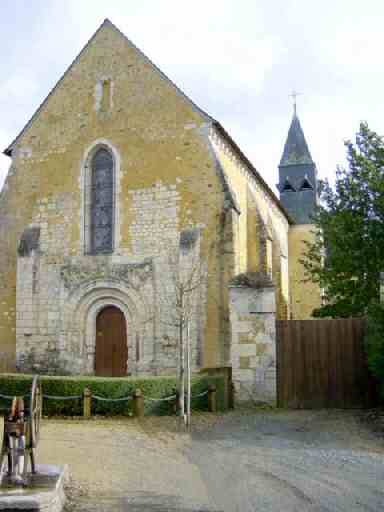
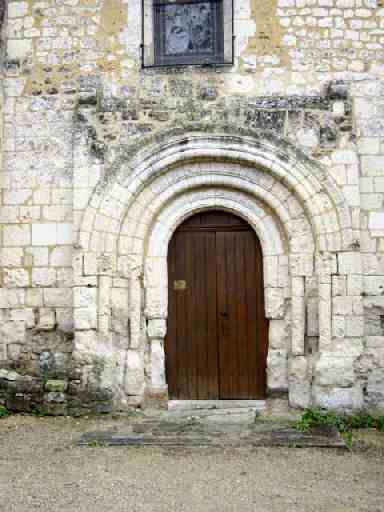
Do not miss the charming church of Pringé (less than a mile in the direction of Mareil). The municipality of Luché deserves our gratitude for saving it from ruin. Considerable work, which lasted about 15 years, has restored it to its original character and charm. There are fine stained glass windows from the 15th, 16th and 17th centuries.
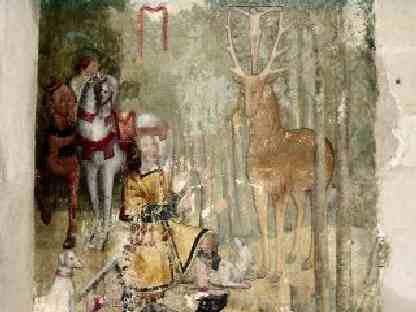
Pringé chapel (12th century): mural painting (15th century): the legend of Saint Hubert. Saint Hubert was so worldly that he chased after a stag on Good Friday. When he caught up with the stag he had a vision of a crucifix between the animal's antlers and was converted. He became bishop of Tongres-Maastricht and later of Liège. He is the patron of hunters.