Home › Churches › Centre-Val de Loire
Meslay-le-Grenet
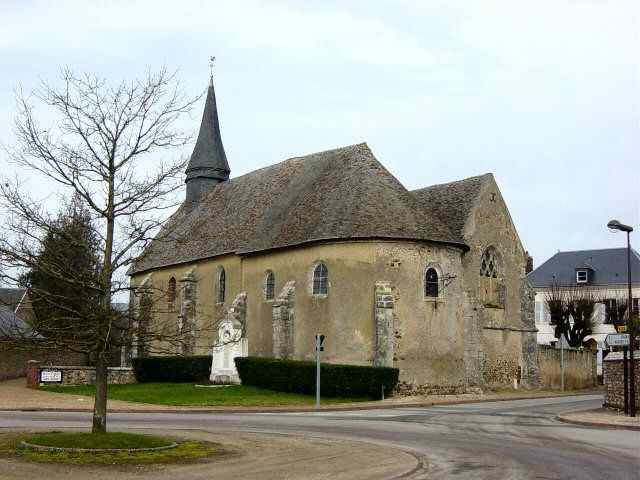
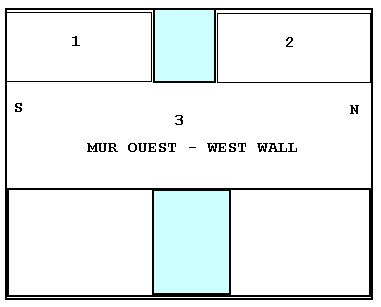
The nave of the church dedicated to saint Orien is Romanesque but a second nave or collateral was added in the 16th century. The church is decorated with a remarkable set of wall paintings dating back to the 15th and 16th centuries, covering the apse, the south and west walls.
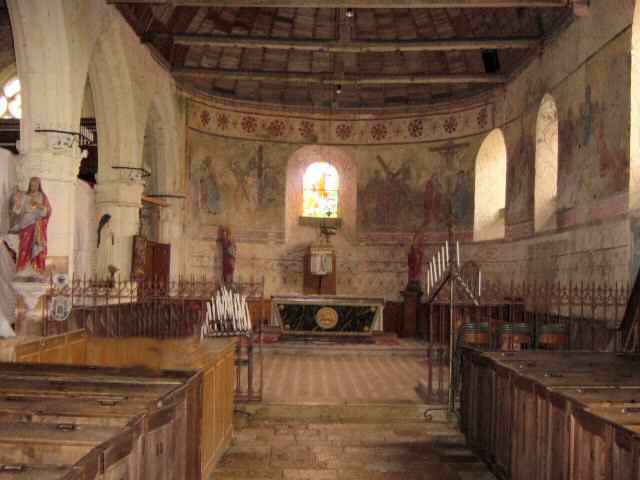
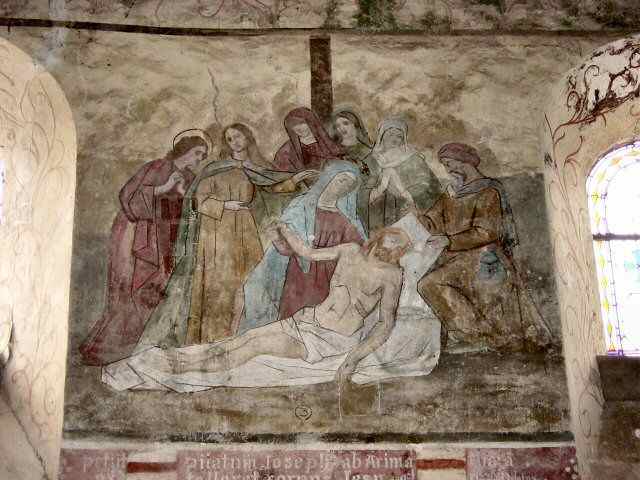
I) - THE SOUTH WALL: - 15th- and 16th-century paintings)
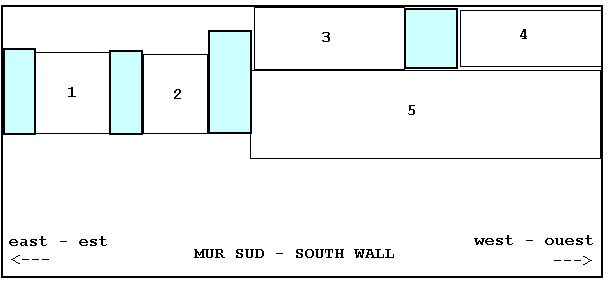
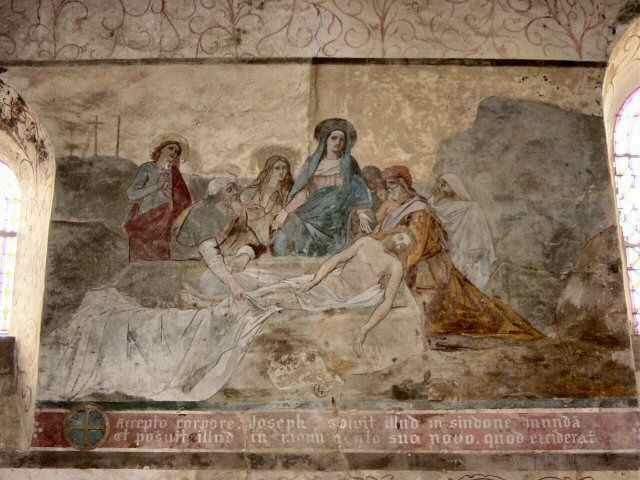
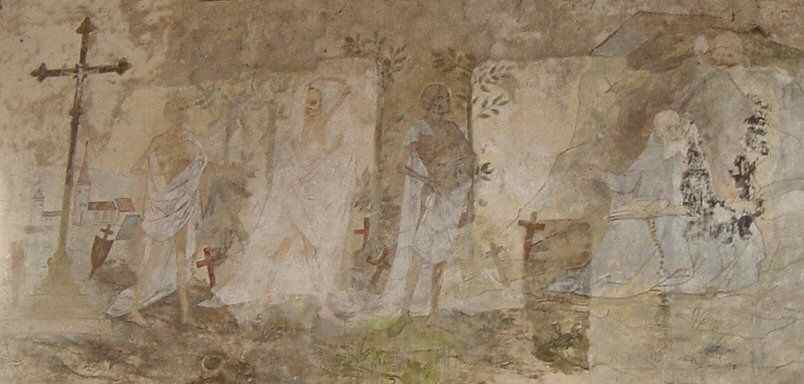
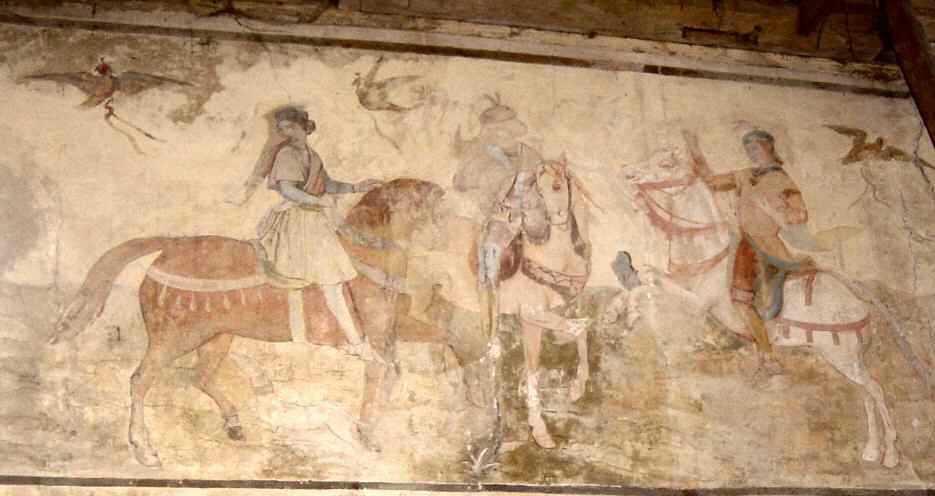
After the Hundred Yeras War and the plagues of the 14th and 15th centuries, "memento mori" became commonplace: skulls, bones, paintings reminded people that was perhaps closer than they thought and that no one, however powerful and rich would be spared. The scene depicting the three dead and the three living meeting in a graveyard is characteristic.
Three young horsemen are hunting with their hawks. In a graveyard, they are stopped by three decomposing dead, who remind them of the brevity of life and of the importance of the salvation of their souls.
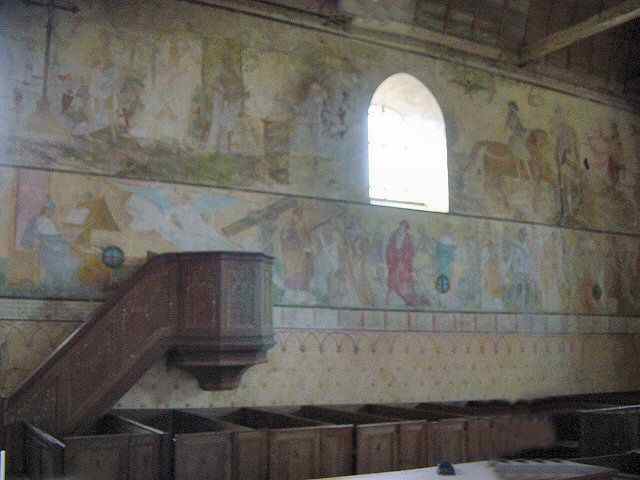
The phrase "Danse Macabre" appears for the first time in the Respit de la Mort, written in 1375 by Jean Le Fèvre.
"I Joined the "danse Macabré
Drawing everyone into its round dance
And leading them to the grave,
Which is their last home."
The source of inspiration of the first iconographies was probably a 14th-century poem in the form of a dialogue between Death and representatives of all social classes and ages. By the 15th century, paintings with verses illustrating the pictures became common. The earliest known example of the Dance of Death was a series of mural paintings (1424-25) in the cloisters of the Church of the Holy Innocents in Paris.
In his book "Man and Death", Philippe Ariès writes:
The dance of death is an endless round dance, in which the dead alternate with the living. The dead lead the dance, in fact, they are the only ones to dance. Each couple consists of a naked, rotting, sexless and very active corpse and a man or a woman, dressed according to their social positions, and astounded. Death reaches out his hand towards the living that he is going to drag to the grave, but who have not yet complied with his invitation. The artistic contrast is between the rhythm of the dead and the paralysis of the living. The moral lesson is to remind men of the uncertainty of the hour of death and to stress that they will all die. All ages and all social positions file in front of us in strict hierarchical order.
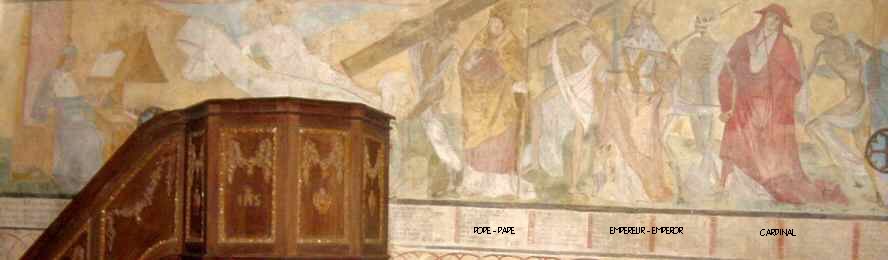
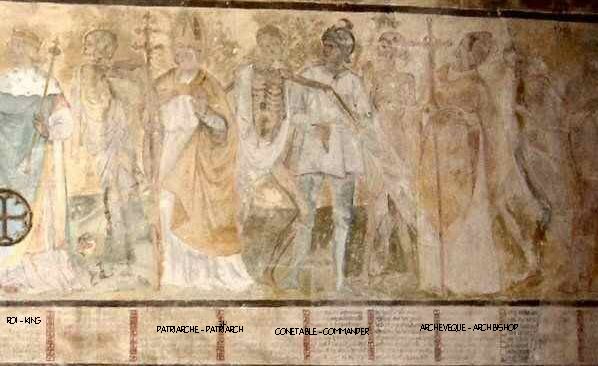
Roi - King * Patriarche - Patriarch * Connétable - Commander * Archevêque - Archbishop
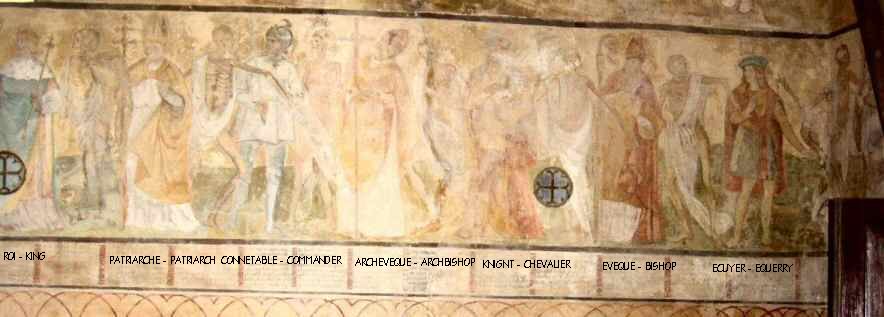
Roi - King * Patriarche - Patriarch * Connétable - Commander * Archevêque - Archbishop * Chevalier - Knight * Evêque - Bishop * Ecuyer - Equerry
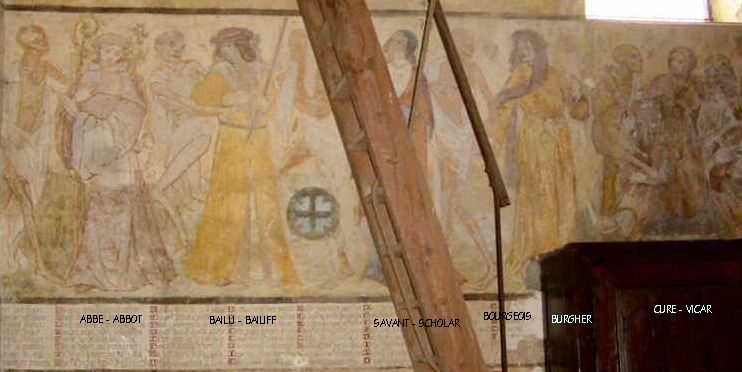
Abbé - Abbot ** Bailli - Bailiff ** Savant - Scholar ** Bourgeois - Burgher - Curé - Vicar
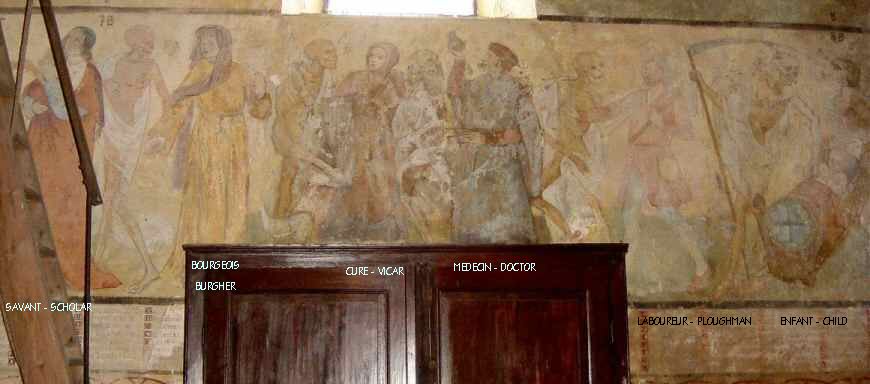
Savant - Scholar * Bourgeois - Burgher * Curé - Vicar * Médecin - Doctor * Laboureur - Ploughman * Enfant - Child (peu lisibles - Hardly legible: Usurier * Usurer * Ermite - Hermit
Examples of the verses below the figures:
Abbot
Abbot, come hither ! Do you fear me?
Do not look so astounded.
It does not become you to fear me.
Do you hate me so much?
Say farewell to the abbey
That fed you well and made you fat.
You will rot speedily: among the dead
The fattest are the first to rot.
Ploughman
Ploughman, you worked and toiled
All your life since you were born,
Die you must, time has come.
Death you should welcome
For all you your worries are at an end
Come hither, I am awaiting you;
Only fools think they will live for ever!
Thanks to Marion Burgin for her useful suggestions
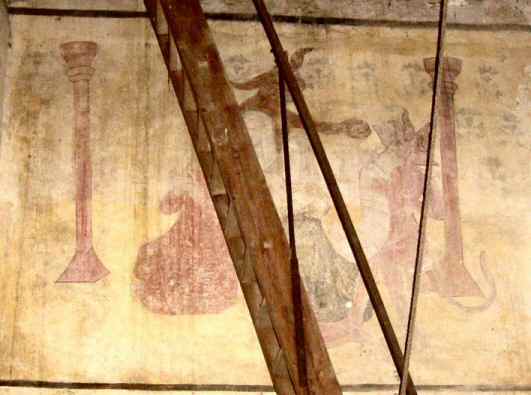
Three women are gossiping. Three demons are recording their conversation. One of them is listening, the second is holding an inkpot and the third is writing. The three demons have cloven feet, bat wings, a tail and horns. This scene illustrates the legend of Saint Martin, bishop of Tours (6th century): During a mass celebrated by the Saint, three women were chattering. The devil, perched on a beam, noted down their malicious conversation. The women kept talking for so long that the devil had to stretch his parchment to go on recording the conversation. The parchment tore, the devil fell and broke his neck.
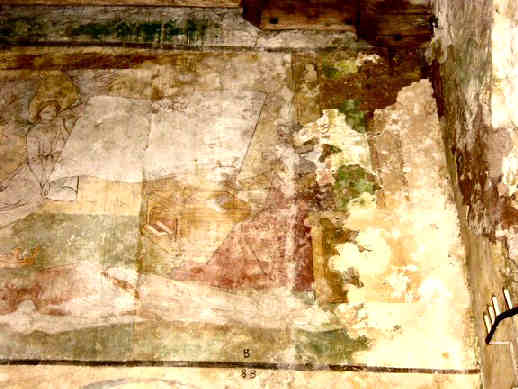
Location and nearby churches
- Varize 34 km
- Lutz-en-Dunois 36 km
- Cloyes-sur-le-Loir 41 km
- Douy 41 km
- Ruan-sur-Egvonne 44 km
- Droué 45 km