Home › Churches › Centre-Val de Loire
Villiers-au-Bouin
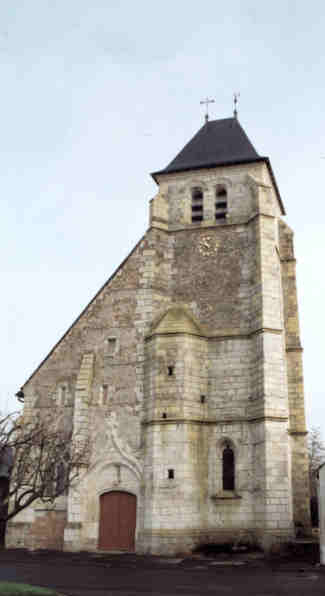
Usually, the visit of a church is a voyage through space: you enter by the west or north door, walk up the nave to the chancel, apse or chevet or, then you explore the aisles, the transept and the side chapels. You are rarely allowed to climb up the tower or crawl down into the crypt, if there is one.
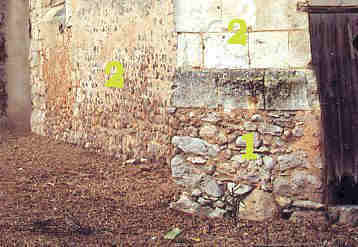
2) Moving west, he would notice that the stones are more regularly aligned and that they all have roughly the same size and shape. Thus in the 12th and 13th centuries, less mortar was needed and the appearance became more pleasant
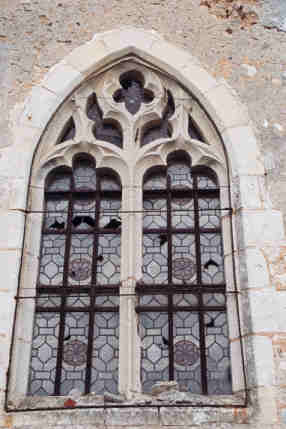
3) Looking up, the 11th-century pilgrim would recognize the window on the left and its rounded arch used since the beginning of the Romanesque period, just like the twin windows at the base of the tower. However, the opening on the right is quite different: larger, surmounted by a pointed arch, it is filled with a decorative tracery and stained glass. More than a century will be necessary for this "fashion" to become widespread.
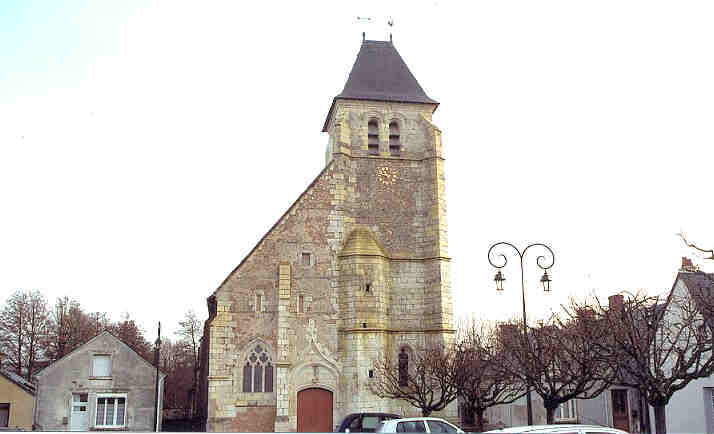
5) Farther west, a Romanesque window, which would not surprise our traveller, a fortified angle turret, not familiar to our pilgrim but whose meaning he would easilly guess: wars and insecurity, which were the lot of many: the Great Plague, the Hundred Years War and the wars of religion in the the 16th century.
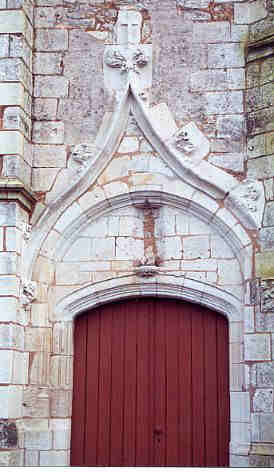
6) But the 16th century also saw the flowering of the Renaissance, which had gradually spread all over Europe since the 15th century. Thus the arch surmounting the door, called a basket handle arch was already known in the 13th century but really became common between the 14th and 16th centuries.It is surmounted by an double curve arch decorated with crockets: this is really the end of the Middle Ages and some similar arches are common in the châteaux de la Loire
LES PEINTURES MURALES
THE WALL PAINTINGS
They date from the 16th century or later, like the coats-of-arms that were part of a funerary "litre" ( a sort of hatchment), which is still visible.
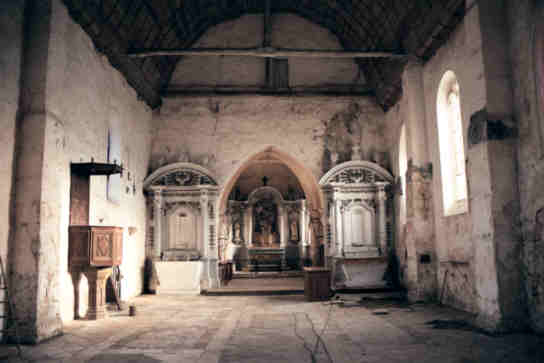
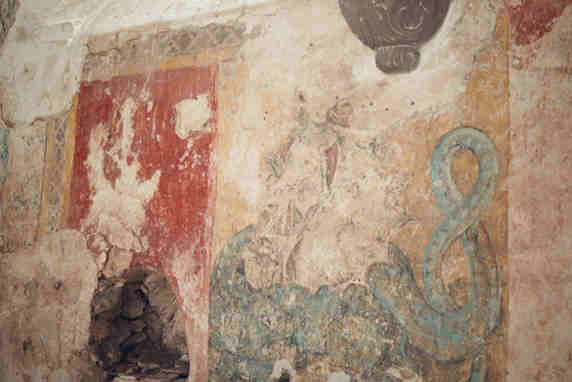
1) Sainte Marguerite d'Antioche - St. Margaret of Antioch:
Few know that St. Margaret is the patron saint of pregnant women and why.
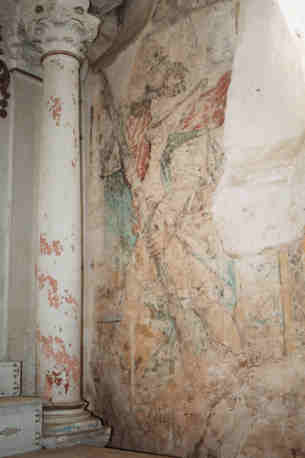
2) SAINT CHRISTOPHE:
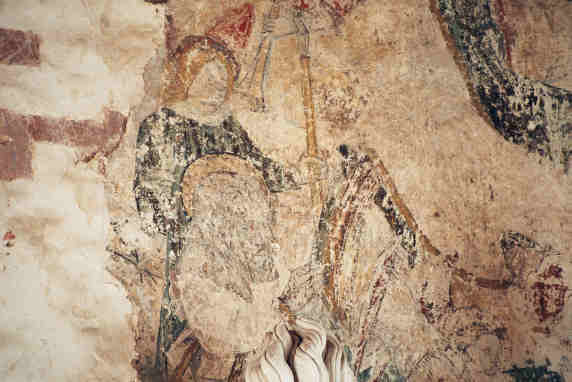
LEGEND
Si aujourd'hui une mort subite est parfois considérée comme une "belle mort", pour nos ancêtres c'était la pire façon de mourir. N'ayant pas eu le temps de se repentir de leurs péchés ni de recevoir les derniers sacrements, ceux qui mouraient soudainement étaient voués à l'enfer et ne pouvaient pas être inhumés en terre consacrée. C'est pourquoi, dans de nombreuses églises, Saint Christophe était représenté plus grand que nature, le plus souvent sous forme de peinture murale à l'entrée de la nef. Rappelons que selon la légende Saint Christophe était un géant qui souhaitait servir le plus grand roi de la terre et finit par être converti au Christianisme par un ermite. L'ermite lui enjoignit de vivre au bord d'une rivière profonde et dangereuse. Grâce à sa taille il pourrait porter les voyageurs et les pèlerins pour leur faire traverser la rivière. Un soir, un enfant lui demanda de le faire traverser. Au milieu de la rivière, l'enfant lui parut de plus en plus lourd, le courant de plus en plus fort et malgré l'arbre qui lui servait de bâton, Saint Christophe eut beaucoup de mal à atteindre la rive opposée. L'enfant - qui était l'Enfant-Jésus - lui expliqua que le fardeau qu'il venait de porter était le poids du monde et de son créateur. Il lui dit de planter son bâton en terre et le lendemain matin, le bâton avait fleuri et portait des dattes.
If nowadays a sudden death is sometimes considered as a "peaceful death", for our ancestors it was the worst possible way of dying. Unable to repent their sins and receive the Last Rites, those who died suddenly were doomed to Hell and could not be buried in consecrated ground. This is why, in many churches, Saint Christopher was represented larger than life, most of the time in the form of a mural painting on the northern wall of the nave. You probably remember that, according to legend, Saint Christopher was a giant who wished to serve the greatest king on earth and finished by being converted to Chritianity by a hermit. The hermit told him to live by a deep and dangerous river. Thanks to his huge stature he would be able to carry travellers and pilgrims across the river. One night, a child asked him to be carried across. Halfway across the river, the child seemed to become heavier and heavier, the current stronger and stronger and even with his tree-staff Saint Christopher could only just manage to reach the opposite bank. The child - he was the Christ-Child - explained to him that the burden he had just carried was the weight of the whole world and its creator. He told him to plant the staff in the ground and the next morning it had bloomed and bore dates.
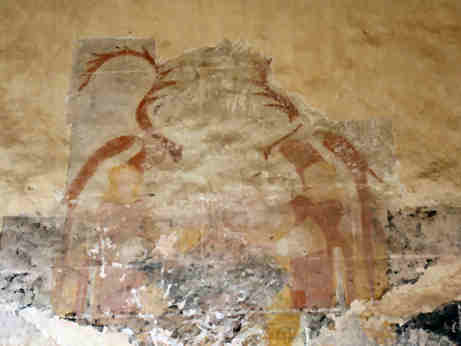
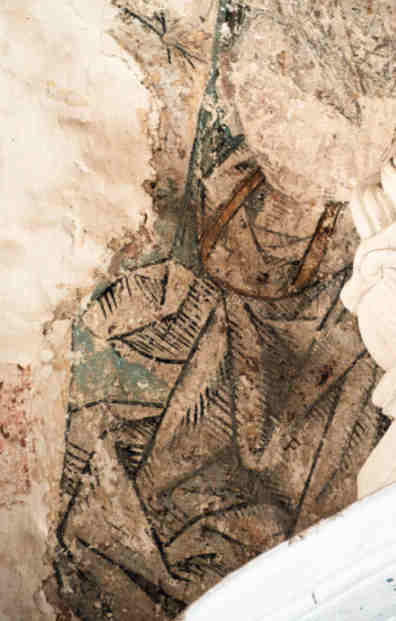
3) SAINTS: - scarcely legible
Location and nearby churches
- Villiers-au-Bouin 0.0 km
- Saint-Germain d'Arce 5.1 km
- Broc 7.1 km
- Vaas 10 km
- Souvigné 11 km
- Channay-sur-Lathan 12 km