Home › Churches › Centre-Val de Loire
Huisseau-en-Beauce
EGLISE NOTRE-DAME
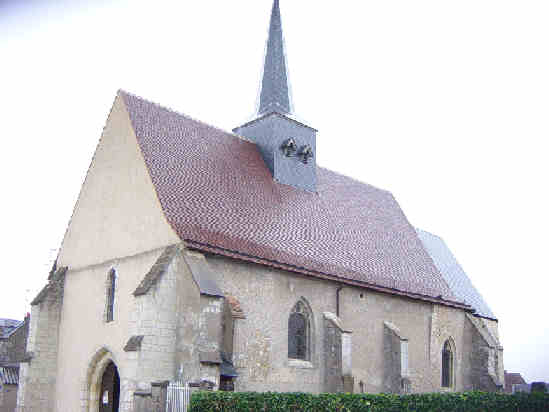
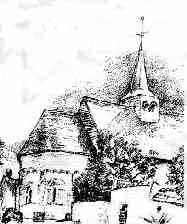
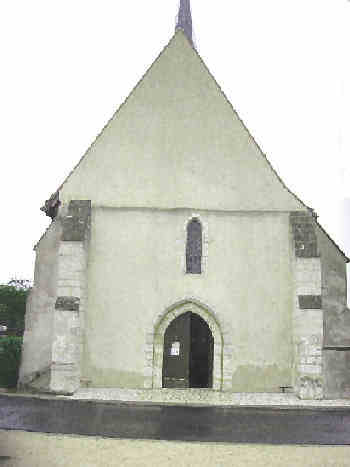
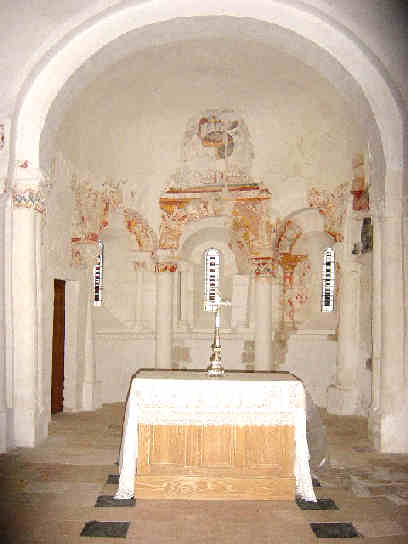
The church, dedicated to Our Lady, dates from the 12th century but underwent important alterations in the 15th and 19th centuries. A complete and careful restoration between 1998 and 2001, has revealed a very fine polychrome chevet and some fine wall paintings
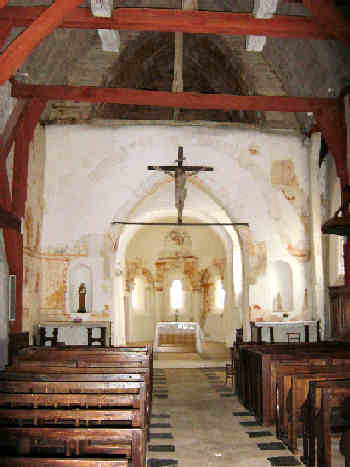
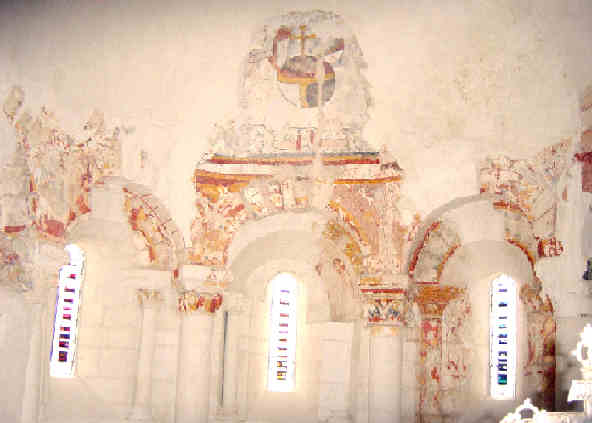
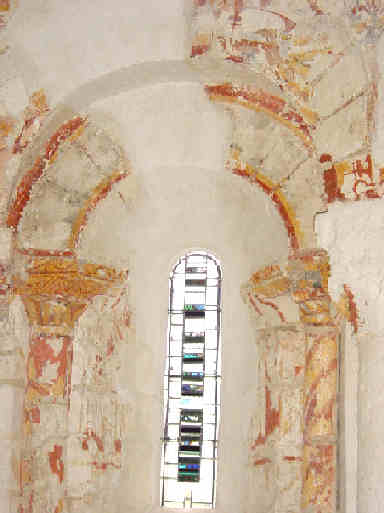
General view of the half-domed apse. The decorative arcatures supported by embedded columns, whose polychromy has been remarkably preserved, gives us a good idea of the brightly coloured decoration of medieval churches. Most of the time, this polychromze decoration has been destroyed. Above the axial window, a Christ of the Last Judgement
THE WALL PAINTINGS
15th century
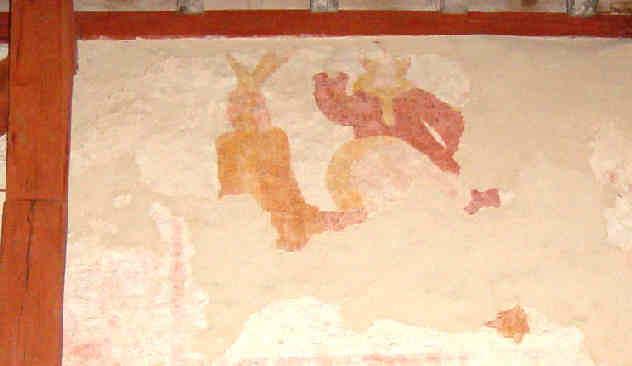
St. Christopher (north wall), upper register. St. Christopher was a man of gigantic stature (he was more than twelve feet tall) and of terrifying appearance. Advised by a hermit, he settled near a river. "So he went to the river and made himself a hut there. In place of a staff he used a long pole to keep himself upright in the water, and, day and night, he carried across the river all travellers who asked his help. After many days of this he was resting in his hut when he heard a child's voice calling to him and saying: 'Christopher, come out and take me across!' He sprang to his feet and went outside, but he could find no one, so he went inside again, but only to hear the same voice calling him again. Again he ran outside and found no one. When it happened a third time and he went out as before, he discovered a child standing at the river bank. The child begged him to take him across, so Christopher lifted him on to his shoulders and, seizing his pole, stepped into the river to make the crossing. But the waters grew gradually rougher and rougher and the child felt as heavy as lead, and the further Christopher went, the higher the waves rose, and the child pressed down on his shoulders more and more until the weight became intolerable. Christopher was in terrible difficulties and feared that he would drown, but after a desperate struggle he finally reached the other side and completed the crossing. Setting the child down on the river bank, he said to him: You put me in great danger, my boy! You weighed so much that if I had had the whole world on my back, it could scarcely have felt heavier!" The child replied:"You should not be surprised, Christopher. You not only had the weight of the whole world on you, you were also carrying him who created the world upon your shoulders! For I am Chtist your King, whom you serve in your work here.
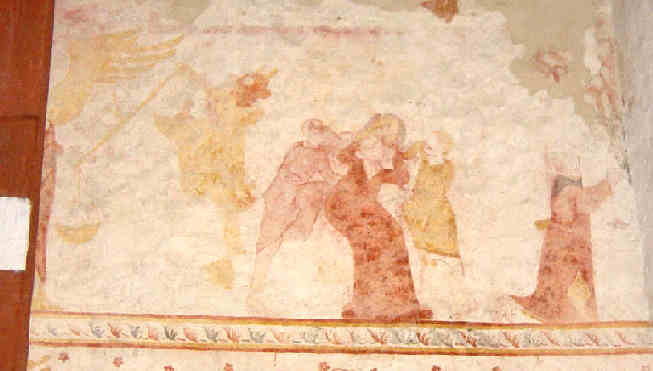
The martyrdom of St. Agatha (north wall), median register. Central scene: St. Agatha, a virgin native of Catana in Sicily, was martyred by consul Quintianus in the reign of the emperor Decius for refusing to sacrifice to the Gods. "He had her tied to a rack and tortured. (...) In fury, Qunitianus ordered them to torture her by crushing her breasts, and when she had suffered in this way for many hours, he finally ordered that her breasts be cut off"... The Golden Legend
The Weighing of Souls (north wall) median register, left scene. The wing of St. Michael can be seen on the left. He is holding the scales while, on the right, a demon is trying to weigh down the righthand pan
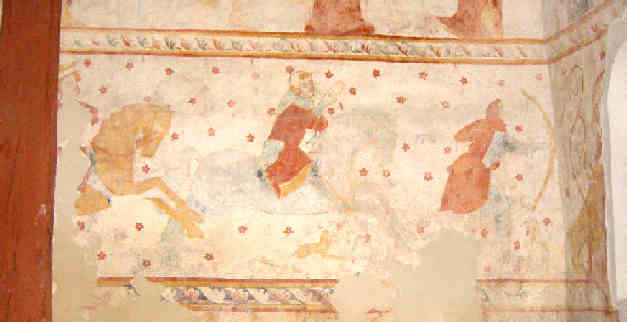
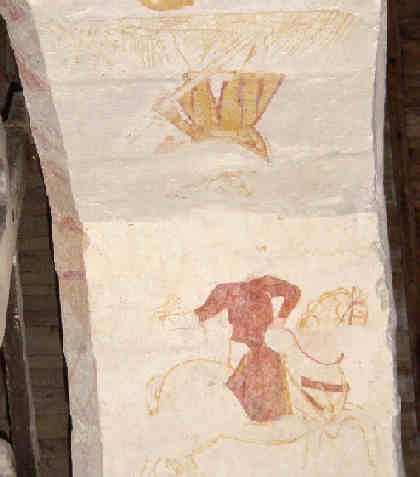
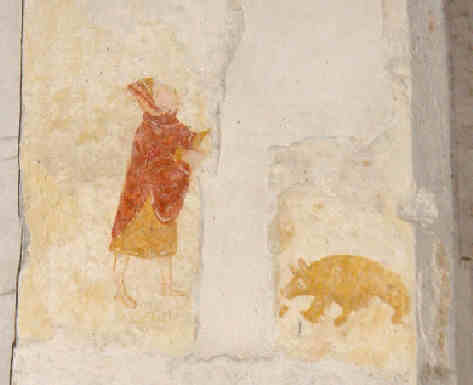
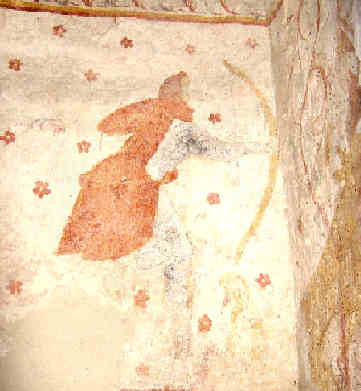
The Hunt of St. Giles (north wall), lower register. St. Giles "headed further into the desert, where he found a cave and a tiny spring, and God sent him a doe which came to him at certain hours and supplied him with her milk. One day some of the king's men came hunting in the locality, and when they saw the doe, they forgot all the other game and chased after her with their hounds. The doe, hotly pursued, fled for refuge to the feet of her foster-son, and Giles, wondering why his doe was making such strange whimpering noises, left the cave to see what was amiss. Hearing the sound of huntsmen, he begged the Lord to spare the nurse he had sent him. (...) Then one of the archers let fly an arrow, to flush the doe out, and dealt the man of God a serious wound as he knelt praying for the animal. The soldiers hacked a path through the undergrowth and came out at Giles's cave, and there saw an old man dressed in monk's habit, white-haired and venerable with age, and the doe stretched out at his feet..." The Golden Legend
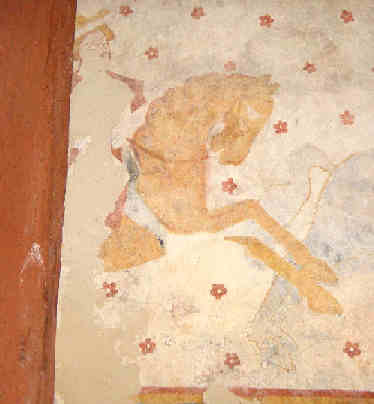
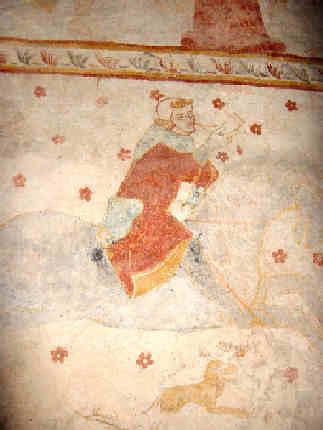
Hunt of St. Giles (close-ups)
LABOURS OF THE MONTHS
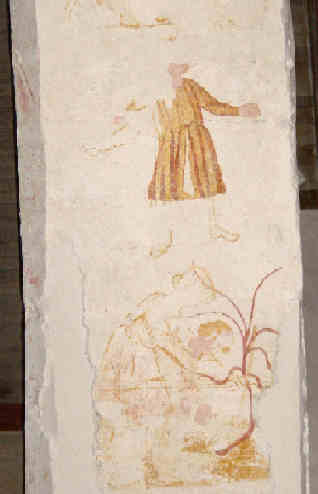
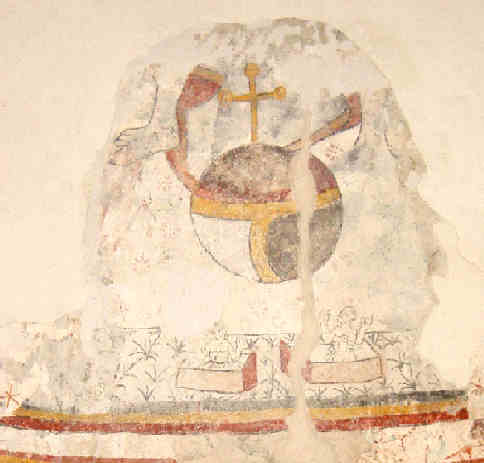
The labours of the months (intrados of the chancel arch). The labours of the months are traditionally associated with religion. This annual cycle is painted on the intrados of the chancel arch. Still fairly well preserved are: vine pruning (March), picking the first flowers (April), hawking (May), haymaking (June), reaping wheat (July), Collecting acorns (October)