Le Douet-Arthus (Heugon)
Eglise Saint-Pierre-et-Saint-Denis
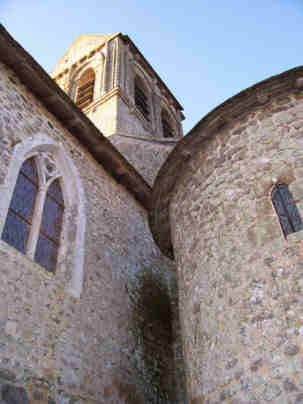
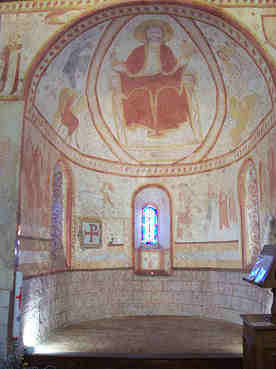
Le Douet-Arthus depends on the village of Heugon. The church, dedicated to St. Peter and St. Denis is of Romanesque origin, but was significantly altered in the 16th an 17th centuries. . This south-east view shows the Romanesque apse and the tower with its round-arched twin windows.
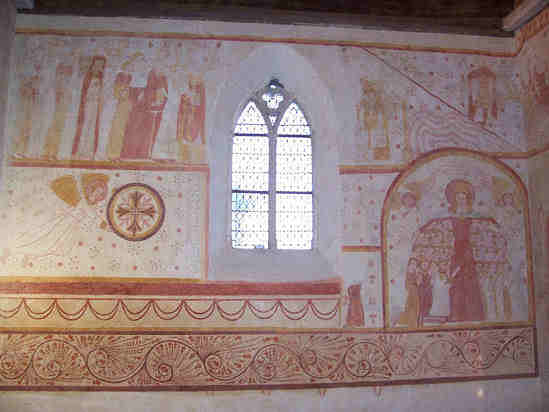
The most interesting one is the scene on the right, which illustrates the legend of St. Ursula and the 11000 virgins.
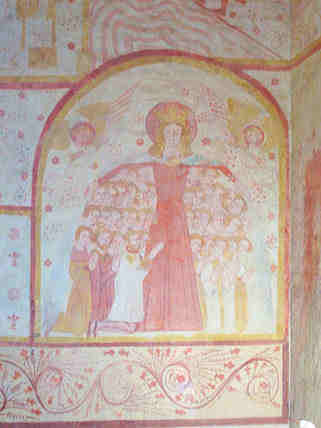
Peu d'épisodes de cette histoire sont attestés par des textes. Nous savons qu' une jeune fille nommée Ursule, fille dun roi chrétien breton, vécut à la toute fin du IIIe et au début du IVe siècle. Nous savons aussi qu'elle refusa d'épouser un prince païen pour demeurer vierge et chrétienne. Par crainte de représailles, Ursule et ses amies dix vierges décidèrent de senfuir.
Le culte d'Ursule, quie les auraient protégées sous son manteau miraculeux et la légende, débutèrent en 1155, quand on découvrit dans une église une petite inscription latine sur une pierre, qui semblait dater du Vème siècle: XIMV. Cette inscription mentionnait la massacre de plusieurs vierges martyres au IIIème siècle.
L'inscription fut comprise comme ONZE (XI) MILLE (M) Vierges alorq qu'elle pouvait se lire ONZE (XI) MARTYRES VIERGES.
Le culte d'Ursule et des Onze Mille Vierges était très répandu au Moyen Âge, en particulier en Allemagne, aux Pays-Bas, dans le nord de la France et en Italie. Malfré son manteau mitaculeux, Ursule fut martyrisée avec ses compagnes. Elles furent plus tard canonisées.Ursule est reconnue comme la sainte patronne des jeunes filles et des drapiers (à cause du manteau). Ses voyages en mer et son naufrage en font la patronne des navigateurs
Le calendrier grégorien a fixé lanniversaire de sainte Ursule et de ses Onze Mille Vierges au 21 octobre. Lorsque le navigateur portugais José Alvarez Faguendes découvrit le 21 octobre 1520, larchipel de Saint-Pierre-et-Miquelon, il constata que ce jour était celui de la fête de sainte Ursule et des Onze Mille Vierges. Christophe Colomb avait fait de même en 1493 en découvrant les îles Vierges (nommées Las Vírgenes).
Few episodes of the story are borne out by documents. We know that a young girl, named Ursula, the daughter of a Christian Breton king, lived in the late 3rd or early 4th century. We also know that she refused to marry a pagan prince to remain virgin and Christian. Fearing reprisals, Ursula and her friends - ten virgins - fled to Rome.
The cult of Ursula, who is supposed to have protected them under her miraculous mantle, and the legend, began in 1155, when a Latin inscription was found in a church, on a stone apparently dating from the 5th century. The inscription mentioned the massacre of several martyred virgins in the 3rd century. It read: XIMV, which could be interpreted as ELEVEN (XI) THOUSAND (M) VIRGINS or ELEVEN (XI) MARTYRED VIRGINS.
The cult of Ursula and the Eleven Thousand Virgins was widespread in the Middle Ages, in particular in Germany, the Netherlands, the north of France and Italy. Despite her miraculous mantle, Ursula and her companions were martyred. They were later canonized. She is recognized as the patron saint of young girls and drapers (on account of the mantle). Her voyages across the seas make her the patron of navigators.
On the Gregorian calendar the anniversary of Ursula and the Eleven Thousand Virgins falls on 21st October. When the Portuguese navigator, José Alvarez Faguendes discovered the archipelago of Saint-Pierre-et-Miquelon on 21st October, he remembered that it was the anniversary of Ursula and the Eleven Thousand Virgins. In 1493, Christopher Columbus made the same remark when he discovered islands, which he named Las Virgenes (the Virgin Islands).
HOME PAGE
Location and nearby churches
- Saint-Sulpice-sur-Risle 23 km
- Norrey en-Auge 31 km
- Dorceau 53 km
- Vezot 56 km
- Saint-Ceneri 61 km
- Saint-Cyr-la-Rosière 63 km